New Report Calls for Systemic Change in Finance Workplaces - Driving Effectiveness, Innovation, and Profitability

September 4, 2025

The Financial Women’s Association (FWA) announces the release of a new white paper, The Post-Pandemic Return Among Women in Finance, authored by cultural anthropologist Dr. Melissa Suzanne Fisher. Commissioned by the FWA, the report examines how return-to-office policies and shifting workplace norms continue to shape careers in the financial services industry and outlines practical steps firms can take to build more resilient, inclusive, and future-ready workplaces.


Based on pandemic and post-pandemic research, the report offers an analysis of challenges that remain highly relevant today: balancing work and family responsibilities, supporting employee well-being, and dismantling systemic barriers that hinder career success. Drawing on interdisciplinary social sciences and firsthand accounts, the report highlights persistent cultural and structural barriers that limit progress across the industry.


The report highlights that while the pandemic's remote work experiments offered employees new ways to balance work and personal life, the push for a full-time return to the office threatens this progress.


Key recommendations highlighted in the report include:

  • Responsibility of caregiving and work/life balance should be shared across the organization, rather than leaving individuals to manage these challenges alone.
  • Firms should focus on addressing bias and discrimination embedded in their systems, not just changing individual attitudes.
  • New models of mentoring and support are needed to reflect evolving work environments (such as hybrid work) and changing employee needs.


Dr. Fisher, author of Wall Street Women, and a faculty member at Parsons School of Design, as well as a Senior Advisor at CFAR Consulting and Coaching Services, argues that supporting employees in balancing work, family, and personal needs is not only the right thing to do - it also drives innovation, effectiveness, and long-term profitability.


The Financial Women’s Association has championed the advancement of women across the financial industry for nearly 70 years. This report adds to that tradition by offering actionable strategies firms can adopt to create more welcoming, supportive, and equitable workplaces so all employees can thrive.


Download the Report

About the FWA


Founded in 1956 by eight trailblazing professionals on Wall Street, the Financial Women’s Association (FWA) is a nonprofit organization committed to supporting leadership, professional growth, and community across the financial industry. With an engaged membership that includes individuals, corporate sponsors, and strategic alliances with educational institutions and other organizations, the FWA provides access to high-impact programming, mentorship, and educational opportunities. Through its numerous events and initiatives, the FWA fosters connection, innovation, and career advancement for those shaping the future of finance.


About Melissa Fisher


Melissa Fisher, Ph.D. is a cultural anthropologist specializing in gender, finance, and workplace culture. She is a Senior Advisor at CFAR, a Visiting Scholar at NYU’s Institute for Public Knowledge, and teaches in the Strategic Design and Management program at Parsons School of Design. Melissa is the author of Wall Street Women and Frontiers of Capital (Duke University Press). Her current research explores equity in evolving workplace environments. Named one of Avuity’s Top 65 Work Tech Experts to Follow in 2025, she consults widely on leadership development and today's complex business needs. Want to explore how anthropological tools and approaches can design a more human-centered workplace? Melissa's consulting services can be found at www.melissafisherphd.com. She is also offering 15 minute free consultations. Connect with her at [email protected].
August 20, 2026
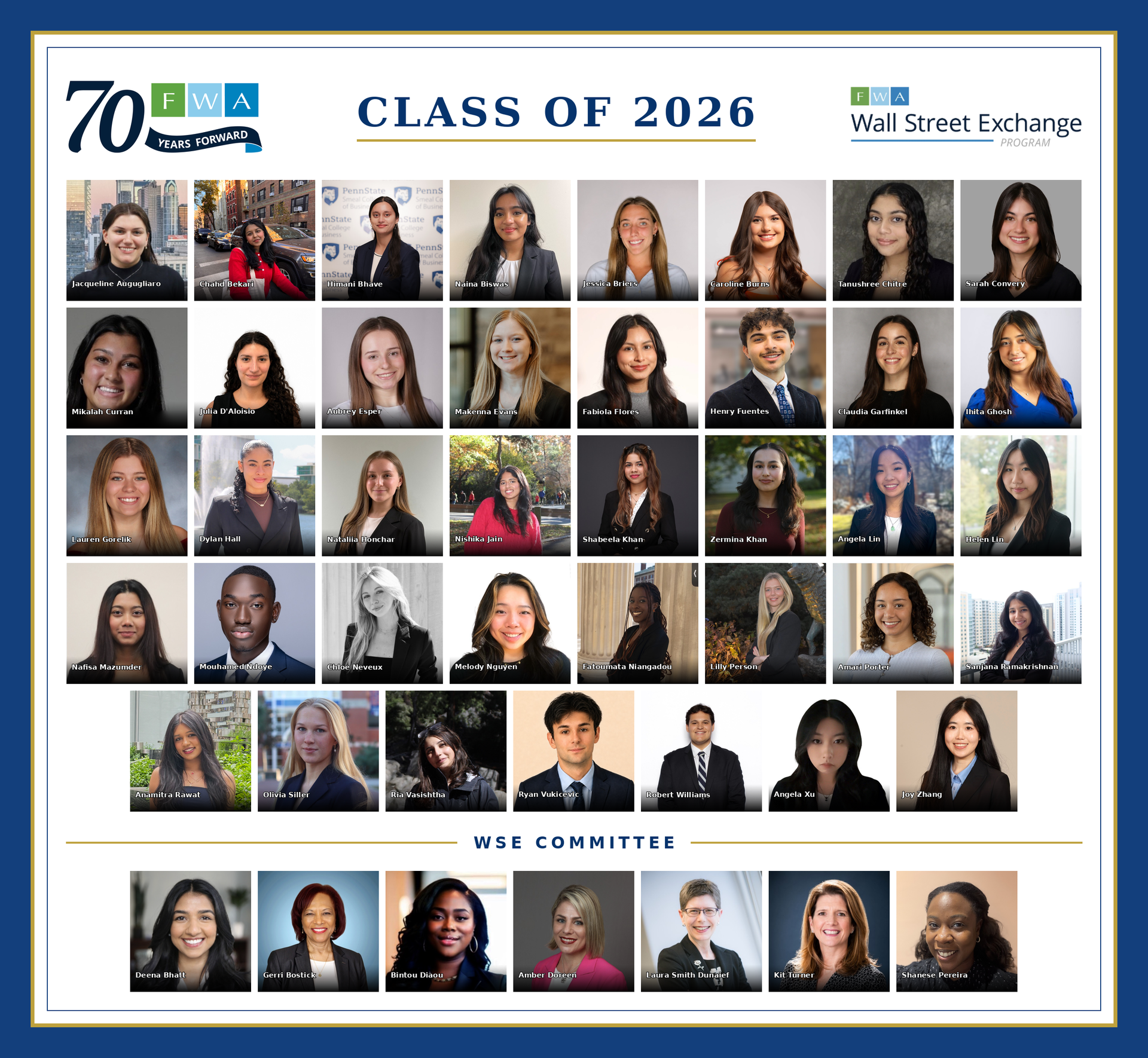
The fifth session of the FWA’s Wall Street Exchange (WSE) Program , held on Tuesday, July 14, brought together students, industry leaders, and a program alumnus for an engaging discussion on the future of finance, financial technology, artificial intelligence, and career development. WSE committee member Amber Doreen welcomed the participants and introduced the session's moderator, Yanique Williams Elliott, a Wall Street Exchange alumna, technologist, founder, and venture capitalist. The discussion featured accomplished professionals representing venture capital, technology, operations, and financial services, Souky Dolinsek, Vice President of Operations at Billford; Shade Alcine, Renewal Manager at Human Security; and Alix Jules, Head of AI Transformation at Broadridge. The panel began by exploring the defining moments that required the speakers to make difficult career decisions. They discussed changing industries, accepting unfamiliar responsibilities, and entering roles that required them to build processes from the ground up. Several panelists candidly discussed experiencing imposter syndrome, especially when entering unfamiliar environments or participating in conversations with senior executives. The panel also explored how artificial intelligence is changing the speed, scope, and nature of financial work. AI can assist with financial modeling, forecasting, bookkeeping, data analysis, investor materials, and other time-intensive responsibilities. Employers will increasingly expect professionals to use AI as a productivity partner. The strongest employees will be those who can combine technological fluency with sound judgment, creativity, and strategic thinking. The discussion explored in depth the intersection of blockchain, tokenization, digital assets, and the rise of digital workforces. Another important discussion focused on the distinction between mentors and sponsors. Mentors speak to you. They provide advice, encouragement, perspective, and guidance while helping you navigate professional decisions. Sponsors speak about you. They are often senior leaders who advocate for you when you are not present, recommend you for significant assignments, and use their organizational influence to support your advancement. As technology continues to evolve, the panel identified several key skills of the future and qualities that will remain essential. Curiosity was highlighted as a particularly valuable quality among 10 others. Interns should ask to attend meetings, learn how other departments operate, and speak with colleagues whose work interests them. Unless a meeting is confidential, employees may be willing to allow an intern to observe and learn. The panel concluded with several memorable lessons for the interns: “Consistency beats perfection.” “Do not become too comfortable.” “Trust the process.” The WSE Co-Chairs, Gerri Feemster Bostick and Laura Smith Dunaief, and the WSE Committee extend their heartfelt thanks to moderator, Yanique Williams Elliott and our panelists, Souky Dolinsek, Shade Alcine, and Alix Jules, for generously sharing their time, experiences, and valuable career insights with our participants.
August 13, 2026
by Robert Brown "I believe that mentorship is incredibly valuable, especially during college as you are navigating a lot of changes and first-time experiences." For Cailyn Kitchens, a junior at Baruch College, those words aren't simply a reflection on her college experience. They've become the foundation of how she's prepared for her future. Following her junior-year internship at Scotiabank, Cailyn credits the Financial Women's Association's Baruch College Mentoring Program and her mentor, Laleh Bashirrad, Managing Director at BNP Paribas, with helping her approach one of the most pivotal chapters of her college journey with greater confidence, curiosity, and perspective.
August 6, 2026
On July 7, 2026, interns in the FWA’s Wall Street Exchange (WSE) Program came together virtually for the fourth session of the summer, titled “Strategic Communications,” sponsored by Joele Frank. Jordan Resnick, HR Specialist, and Heather Wallach, Talent Acquisition Manager, introduced interns to Joele Frank and the world of strategic communications, a field many interns had never considered as part of the financial services landscape. Jordan and Heather explained that Joele Frank advises companies through their most consequential moments, from mergers and acquisitions to shareholder activism, restructuring, leadership transitions, and crisis response, ranking as the #1 U.S. M&A PR advisor and #1 shareholder activism defense advisor in the industry. To bring the firm’s work to life, Jordan and Heather walked interns through several high-profile engagements, including Joele Frank’s support of Warner Bros. Discovery, a current client, as an example of how the firm helps companies navigate high-stakes, high-visibility situations in real time. The discussion underscored that effective strategic communications require not just managing a narrative, but protecting a company’s credibility with every audience watching, from investors and employees to the media and the public. Jordan and Heather also broke down the many disciplines that fall under the strategic communications umbrella, including investor relations, corporate and media relations, governance and corporate stewardship, design, and digital strategy. They emphasized that the firm hires like a law firm, bringing on Account Associates directly out of undergrad, and encouraged interns interested in the field to build strong writing skills, stay current on financial news through outlets like The Wall Street Journal and Bloomberg, and consider Joele Frank’s summer internship or full-time Account Associate programs as a path into the industry. Interns had the opportunity to ask questions throughout the presentation before breaking into small groups to discuss their key takeaways from the session and reflect on what they had learned so far this summer. Many interns shared that the session reshaped their understanding of what a career in PR actually looks like, moving past common misconceptions to reveal a discipline built on strategy, judgment, and relationships. Several groups also highlighted the session’s emphasis on soft skills, noting how much communication, adaptability, and emotional intelligence matter in a field so often mistaken for being purely about writing press releases. At the conclusion of the session, the WSE spun the wheel to award a CFA Society Student Membership, sponsored by the CFA Society, to Sarah Convery. Congrats, Sarah! A huge thank you to Jordan Resnick, Heather Wallach, and the entire Joele Frank team for giving interns a behind-the-scenes look at the strategic communications industry. The WSE Co-Chairs and Committee extend their sincere thanks and appreciation to the President’s Circle Firms, the Partnership Circle Firms, and the Friends of FWA for their unwavering support and generosity to the interns and the Wall Street Exchange Program. 
July 30, 2026
On June 23, 2026, the FWA's Wall Street Exchange (WSE) Program 2026 cohort gathered virtually for the third weekly session of the program. The session was sponsored by Knopman Marks, a boutique NYC-based firm known for its high-performance training for securities licensing exams. Brian Marks, Co-Founder and President of Knopman Marks & Highwire, led a practical, high-energy conversation titled "Foundations for Professional Excellence." The first topic that Brian discussed was the habits that drive a successful early career and why those habits matter well beyond an internship. The skills interns build now are the same ones that separate a good intern from a great one; and that later separate a good professional from a high performer. He described high performance, not as a matter of raw talent, but rather as a set of behaviors one can practice. The habits put in place early are the ones that compound. The interns who start practicing them now are the ones who carry them from an internship with limited responsibilities into executive-level responsibility later. The interns then reviewed a series of four credibility builders and four credibility killers, proactive behaviors that shape how senior professionals come to trust a young professional. Owning your mistakes and learning from them is a key credibility builder and surprising your manager with bad news at the last minute is a major credibility killer. The interns then rated themselves on a Strategic Action Matrix, a four-box framework charting how strategy: “Are you focused on the right things?” interacts with execution: “Are you doing the work to get there?”. He asked interns to consider one or two new habits they could put to work immediately. Brian impressed upon the interns that professional excellence is thinking strategically and executing well, while stepping outside their comfort zone, stretching past their limits and building resilience when the plan changes. Brian then introduced the five strategies in The Intern Success Playbook, emphasizing that interns are building their personal brand every day through what others observe. Whether it's staying focused instead of constantly checking a mobile phone or taking the initiative to connect with colleagues, everyday actions shape how others perceive them. His five strategies focused on working and communicating smarter, building authentic relationships, and paying close attention to perception and details. The interactive format kept energy high. Interns enjoyed the live Q&A, the quiz, and the chance to ask questions. A screen full of Zoom hearts spoke to the value they found in his advice. A huge thank you to Knopman Marks and Brian Marks for investing their time and expertise in the WSE 2026 cohort. The session concluded with the WSE Committee awarding intern Sarah Convery a CFA Student Annual Membership, sponsored by the CFA Society. The WSE Co-Chairs, Gerri Bostick and Laura Smith Dunaief, and the WSE Committee extend their sincere appreciation to Brian Marks and Knopman Marks for their support in making this virtual session a success. We also thank the FWA President Albana Theka, FWA leadership, volunteers, sponsoring firms, and participating employers for their continued commitment to providing this valuable experience to the next generation of financial professionals. 
More Posts